



She also supports reading the room.
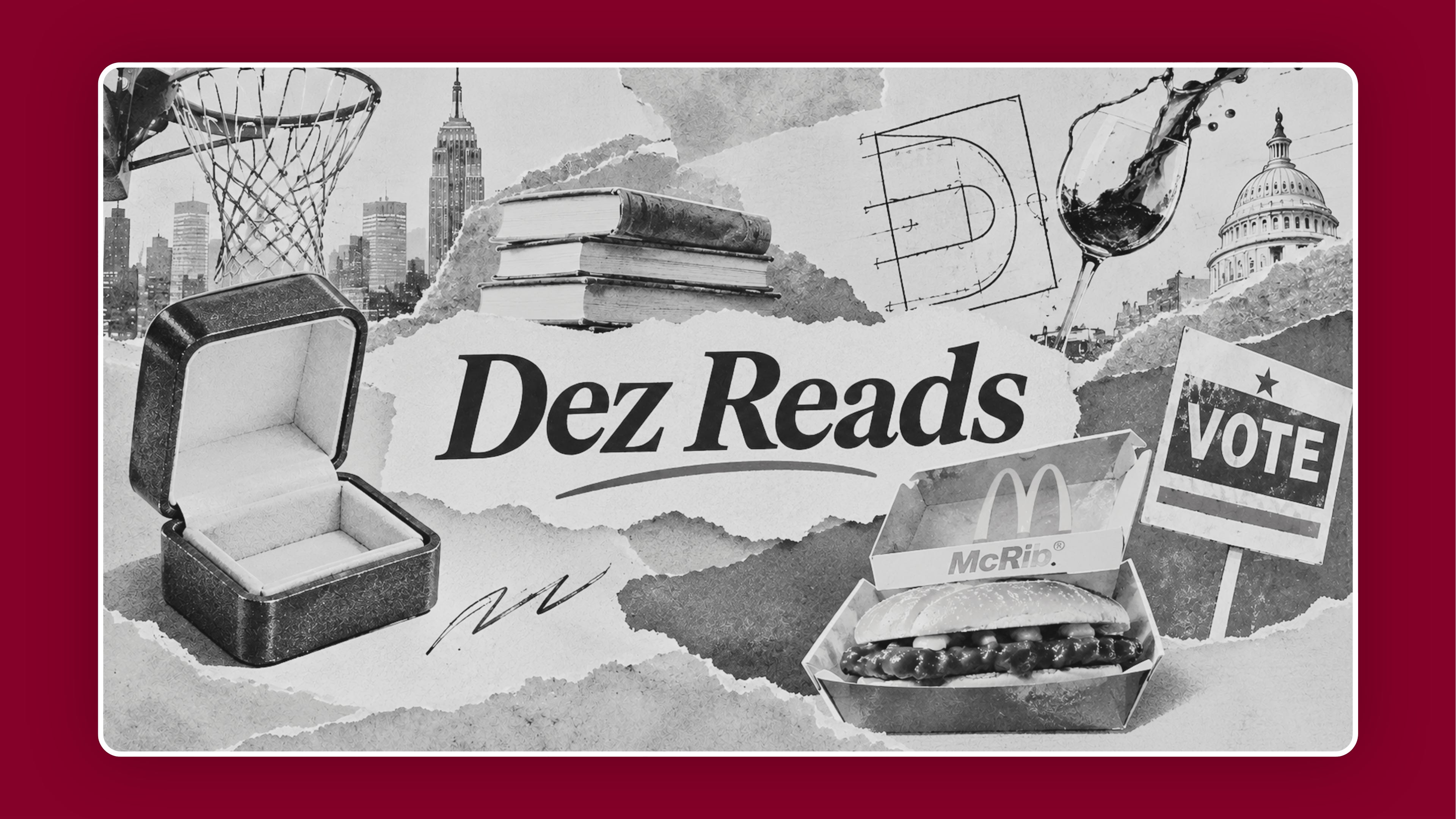
One of Dezenhall’s esteemed New Yorkers, Helen Taylor, kicks us off this week by putting Knicks owner James Dolan on blast for taunting his own employees in heinous fashion. I was heartened to see the entire internet echo her sentiment during a rare extended online news cycle.
Sam Jefferies is concerned that boys aren’t reading enough. Welcome to the #PrintGang, Sam, and take your kids to the bookstore this weekend, folks.
McDonald’s has been in the news a lot lately, as the burger wars are getting intense. Shoutout Jen JLC Condon for fulfilling Dez Reads’ annual McRib content quota with a look at some deliciously esoteric litigation regarding rib meat.
New guy Ryan Oster makes his debut this week and reveals that he is (yet another) Philly sports fan, which means he has to pretend LeBron James is cool. To be fair, he captures the excitement of fandom when your team suddenly experiences superstar-level viral media moments almost every time they play. Welcome to the firm, Ryan.
Ava Sheehan brings us home by tying together the election cycle with her own creative genius, examining the importance of strong and compelling branding in James Talarico’s huge win in Texas.
This one is a very good read – shoutout to the whole team.
Thanks, as always, for reading along with us.
Here we go.
Phishing for a Championship Ring.
CBS Sports. Knicks reportedly duped employees with championship ring email that was actually a phishing test.
As a New York City transplant, the Knicks winning a championship was a huge serotonin boost during the city’s “most epic summer.” I celebrated in the streets outside the Garden, surrounded by strangers who felt like friends. Nothing makes you feel part of this city quite like celebrating alongside it.
Which makes this championship ring situation such a letdown.
Employees reportedly received an email offering championship rings, only to discover it was a phishing test. Assistant coaches got empty ring boxes during the opening night ceremony. Apparently, even celebrating a championship for the first time in a decade comes with terms and conditions.
I support cybersecurity, but I also support reading the room. Surely a fake password reset could have accomplished the same thing without dangling a piece of Knicks history in front of people who helped make it happen.
The players deserve their flowers, but so do the coaches and employees working behind the scenes. Not everyone needs a diamond the size of a basketball. Still, appreciation should not come disguised as mandatory IT training or a beautifully packaged IOU.
The Knicks gave New York a summer to remember. The people who helped them along the way deserve a celebration without a catch.
– Helen Taylor
Newness, an Old Obsession.
The Atlantic. An Underrated Reason Boys are Reading Less.
Americans have long been obsessed with newness. As Don Draper once put it, “the most important idea in advertising is ‘new.’ Creates an itch. You simply put your product in there as a kind of... calamine lotion.”
Songs, music, books, tv shows. Politicians and pickleball, fashion styles and diets. We are always on the hunt for the next thing, driven to search by shiny object syndrome.
I loved Sophia Nguyen’s latest piece in The Atlantic, in which she examines a literary world that skews heavily towards female protagonists. Realistic fiction and mystery genres involve female leads at three times the rate of male ones.
At a moment when child literacy is falling, and boys are struggling with reading more than girls, and when attention spans are being rapidly reduced by short-form video on social media, boys are struggling to see themselves in the fiction they are being offered. I get that. Seeing yourself in art can keep you interested all the way to the end. But do we need new books to fix the ratio? There are plenty of great male characters in the canon, just as there are timeless female characters throughout the ages.
If we need inspiration and insight, for ourselves, our kids, or our peers, why not look backward? Great art is timeless. If new is no longer a calamine, it might be time to just dust off the classics.
– Sam Jefferies
The Missing Rib and a Reputation Problem.
NYT: A Lawsuit Says the McRib is Lacking Something You Might Expect It to Have.
McRib, the popular McDonald’s sandwich, is facing a lawsuit alleging that since it’s called the McRib, and shaped like ribs, it should contain rib meat.
The judge in the case has allowed parts of the lawsuit to move forward against McDonald’s. The company denies the allegations.
One could write a whole thesis on branding based on this lawsuit. The McRib (which, like me, will celebrate its 45th birthday this year), has cultivated a half-century following through clever advertising, nostalgia, and making people think it’s something to covet by offering it only during certain seasons. Ok, yeah, the name is pretty genius too. But when you establish a following based on a clever name, the texture of your product, and commercials, people don’t necessarily want to read the ingredient label.
McDonald’s, for its part, says it clearly lists the ingredients of the McRib. The plaintiffs in the lawsuit claim otherwise. Either way, the courts will rule on that matter.
But for brands, the lesson here is that even if you spend billions building customer loyalty, three letters in your product name can lead to a very expensive lawsuit.
In reputation management, perception is reality; apparently what’s in between the bun is too.
– Jennifer Condon
Lebron Teaches a Life Lesson.
ESPN. LeBron James takes sip of wine after crashing into 76ers fan.
As a lifelong Sixers fan, I’ve developed a system: watch the season opener, then return for our customary second round playoff exit. It saves time and disappointment.
Even adding LeBron James this offseason couldn’t undo 25 years of expectation management. I watched the first two games, admittedly, but was ready to leave it alone until spring.
Then a video of LeBron came up on my feed. After chasing a loose ball into a fan carrying red wine, he paused, helped himself to a sip, and returned to the court.
My immediate thought: I should probably be watching this season.
I’d gotten so good at avoiding the disappointment that I was missing the fun, even with [arguably] the greatest of all time wearing my team’s jersey. Apparently, my strategy for enjoying basketball involved watching as little of it as possible.
As James put it, “If you don’t find ways to have fun throughout it, even though you’re working, even though you’re locked in, then it could wear on you.”
Nobody in DC needs another reminder to have a drink. But a reminder to enjoy something before we know how it ends? We could all use that.
– Ryan Oster
Disrupting the Political Palette.
Fast Company. The midterms’ biggest branding trend? Centrism.
My definition of successful branding is effective visual storytelling that communicates key messages and evokes thoughts and emotions – and, if done right, action. In the recent midterms, centrist campaign branding became a trend and influenced results at the polls.
This is exactly what Griffin Glaze Creative achieved. The visual identity of James Talarico’s campaign does more than stand out in a sea of red and blue – it sets the tone for who he is and what he stands for. The simple black and white palette with red and blue accents, paired with rough, textured type, communicates confidence and authenticity.
“Are you an Aggie or a Longhorn?” I grew up in Houston, and one of my earliest memories is of a classmate asking me this on a hayride – with the conviction of a Baptist preacher. In Texas, you can bleed maroon or burnt orange and still be treated with hospitality by the opposing team. To me, the campaign’s restrained use of color cleverly signals one team, not two sides, to a Texan audience.
Don’t underestimate how effective branding can cut through the noise and resonate with people.
– Ava Sheehan