


For nearly five years, I had the privilege of leading America250, the national, nonpartisan organization established by Congress to commemorate and celebrate the 250th anniversary of the signing of the Declaration of Independence.
I came into the work believing America was deeply divided.
I leave believing something different.
Yes, America can be a loud, argumentative society, at times deeply divided over aspects of our government, history, institutions, and future. But after traveling across the country and meeting Americans from all walks of life, I came to realize there is much more that unites us than the national conversation suggests.
The visible divisions are easy to recognize. We live in a world where our media is fragmented. People increasingly consume different facts, narratives, and even descriptions of the country itself. Conflict receives more attention, and outrage spreads faster than optimism. The quiet efforts of Americans helping each other solve problems in their own neighborhoods are hardly ever featured in the news.
We quickly learned that what motivates or inspires one group may have little impact upon another. This became one of the biggest challenges and greatest lessons in leading America250. When our objective was to reach 350 million Americans for the 250th, “350 for 250,” we soon discovered that no single message could effectively engage all Americans. Each American had to see themselves in the narrative. The invitation had to feel personal.
In Boston, America250 focused on the American Revolution and the city’s historic pursuit of liberty. In Fairbanks, we emphasized Alaska’s frontier spirit, Native communities, military service, and innovation.
Neither story was more “American” than the other. That was exactly the point. Our responsibility was never to tell Americans what America means to them. Rather, it was to provide them with an opportunity to share with us.
This required building a national framework while also creating 56 separate State and Territory Commissions. We needed to build relationships with Governors, state legislatures, and, most importantly, those closest to their communities. These individuals knew what their neighbors care about, what issues would unite them, and what would turn them off.
As a result, we did not develop 56 separate versions of the same campaign. Rather, we developed 56 curated expressions of an American story.
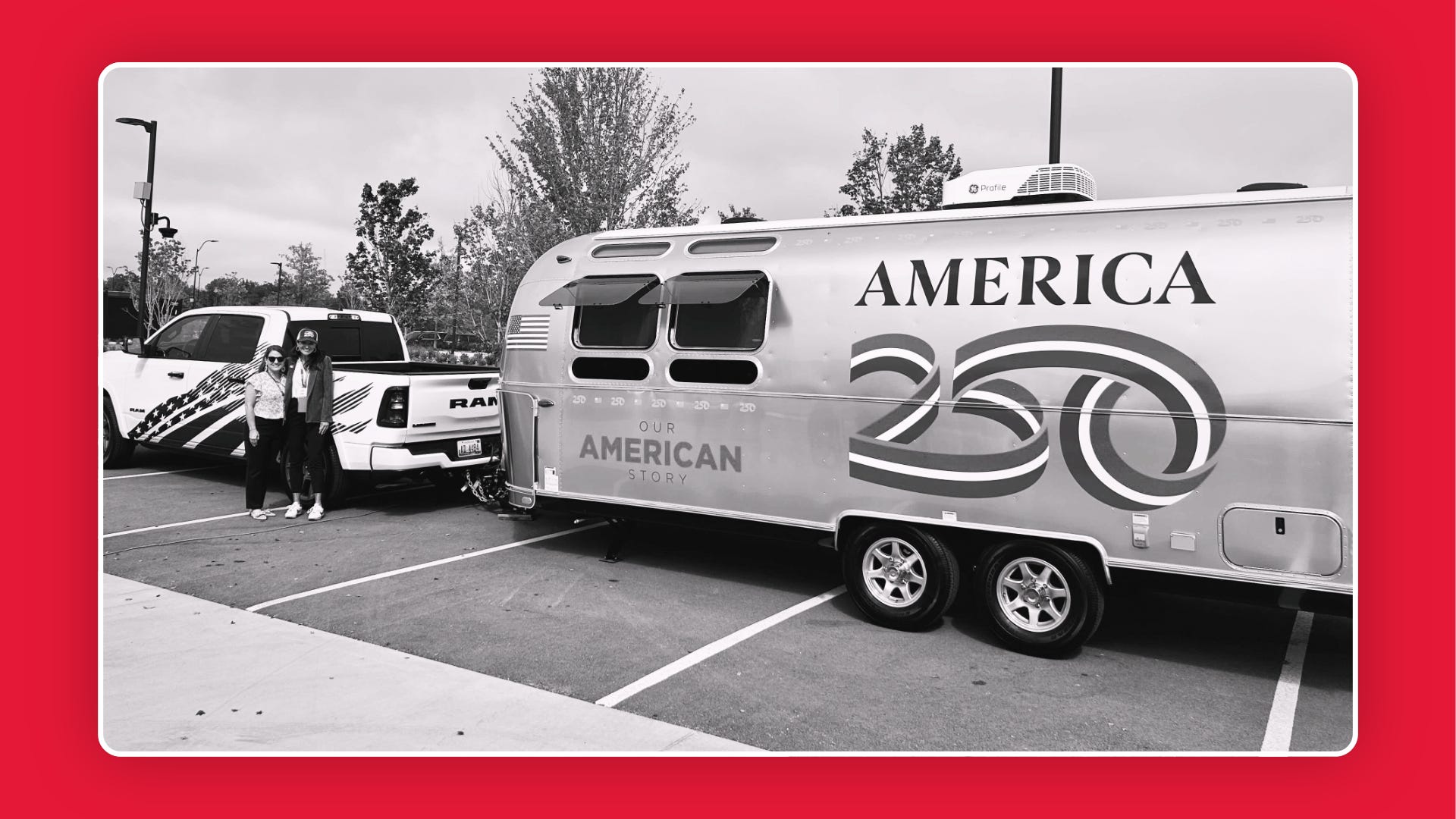
One of America250’s major initiatives, Our American Story, attempted to do just that. This year-long program travels across America, collecting thousands of interviews with everyday Americans in all 50 states. At each stop, we ask: “What does America mean to you?” To date, the team has traveled thousands of miles in an Airstream visiting small towns and main streets engaging in conversations that can only happen when you meet people where they are.
Time and time again, the common theme, regardless of what state we were in, was a deep desire for unity and a willingness to help others. In Arkansas, I spoke with the owner of a veteran-owned coffee shop that gives back to sick and injured firefighters and, when needed, deploys a disaster-relief fire truck. In Alabama, I spoke with a man who grew up on a family farm in a one-stoplight town where “if you wanted to eat, you grew what you ate.” His life has been centered on serving others first, through military service and later by attempting to unite his state serving on the Alabama250 Commission.
While their stories were different, the lesson was identical. Often, patriotism is demonstrated less by what Americans say about America and more by what they do for one another.
Our research further supported what I personally witnessed. In one America250 survey, 92% of adults reported feeling unified in wanting to help make America a better place for all Americans to live. Americans were not necessarily asking us to resolve every disagreement they might have. What they were asking for was far simpler: Provide us with something worth coming together for.
Throughout my time at America250, I saw people with varying political views work together because they wanted to support their communities. Americans are eager for a shared narrative that transcends their partisan identity and greatly differs from how they are portrayed on social media. To accurately represent America, we had to cut through the noise and meet Americans where they were. We had to go talk to them in their communities about the issues they cared about. It was information that couldn’t be gathered by a snap poll or a review of the social media conversation in a state. That is what makes any campaign truly successful. Meeting people where they are wasn’t a marketing stunt. We lived it.
While commemorating the 250th anniversary will not eliminate America’s differences, no historical milestone could, I leave America250 today more confident than ever that we are fundamentally more united than divided.
Jennifer Condon is the former CEO of America250 and a public affairs and crisis management executive at Dezenhall Resources, LTD.
Editor’s note: This op-ed was originally published by RealClearHistory on October 12, 2026.
